

Act
Next Steps: Learning a Disentangled Gait Representation for Versatile Quadruped Locomotion
Mitchell AL, Merkt W, Geisert M, Gangapurwala S, Engelcke M, Parker Jones O, Havoutis I, Posner I
2022 International Conference on Robotics and Automation (ICRA)
Quadruped locomotion is rapidly maturing to a degree where robots now routinely traverse a variety of unstructured terrains. However, while gaits can be varied typically by selecting from a range of pre-computed styles, current planners are unable to vary key gait parameters continuously while the robot is in motion.
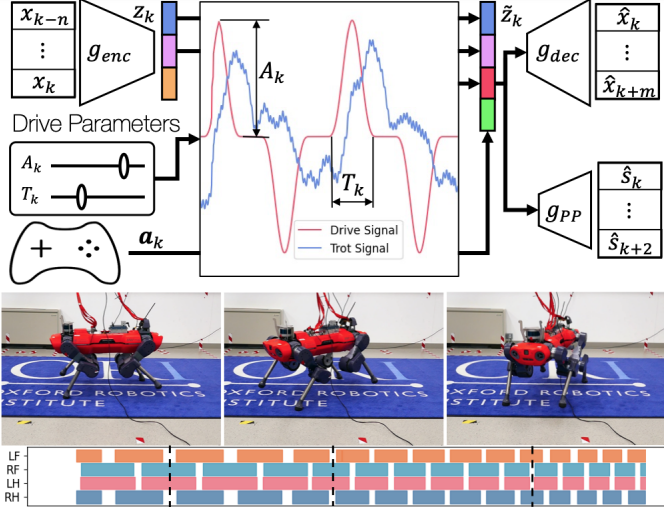
The synthesis, on-the-fly, of gaits with unexpected operational characteristics or even the blending of dynamic manoeuvres lies beyond the capabilities of the current state-of-the-art. In this work we address this limitation by learning a latent space capturing the key stance phases of a particular gait, via a generative model trained on a single trot style. This encourages disentanglement such that application of a drive signal to a single dimension of the latent state induces holistic plans synthesising a continuous variety of trot styles. In fact properties of this drive signal map directly to gait parameters such as cadence, footstep height and full stance duration. The use of a generative model facilitates the detection and mitigation of disturbances to provide a versatile and robust planning framework. We evaluate our approach on a real ANYmal quadruped robot and demonstrate that our method achieves a continuous blend of dynamic trot styles whilst being robust and reactive to external perturbations.
Leveraging Scene Embedding for Gradient-Based Motion Planning in Latent Space
Yamada J, Hung CM, Collins J, Havoutis I, Posner I
IEEE International Conference on Robotics and Automation (ICRA), 2023
Motion planning framed as optimisation in structured latent spaces has recently emerged as competitive with traditional methods in terms of planning success while significantly outperforming them in terms of computational speed. However, the real-world applicability of recent work in this domain remains limited by the need to express obstacle information directly in state-space, involving simple geometric primitives.

In this work we address this challenge by leveraging learned scene embeddings together with a generative model of the robot manipulator to drive the optimisation process. In addition, we introduce an approach for efficient collision checking which directly regularises the optimisation undertaken for planning. Using simulated as well as real-world experiments, we demonstrate that our approach, AMP-LS, is able to successfully plan in novel, complex scenes while outperforming traditional planning baselines in terms of computation speed by an order of magnitude. We show that the resulting system is fast enough to enable closed-loop planning in real-world dynamic scenes.
Other related publications
Reaching through latent space: From joint statistics to path planning in manipulation
Hung C-M, Zhong S, Goodwin W, Parker Jones O, Engelcke M, Havoutis I, Poser IJournal: IEEE Robotics and Automation Letters
Efficient Skill Acquisition for Complex Manipulation Tasks in Obstructed Environments
Yamada J, Collins J, Posner I
March 2023 | preprint
From Machine Learning to Robotics: Challenges and Opportunities for Embodied Intelligence
Roy N, Posner I, Barfoot T, Beaudoin P, Bengio Y, Bog , Brock O, Depatie I, Fox D, Koditschek D, Lozano-Perez T, Mansinghka V, Pal C, Richards B, Sadigh D, Schaal S, Sukhatme G, Therien D, Toussaint M, Van de Panne M
October 2021 | preprint